


Hey there! As a supplier of fixed supports, I often get asked about how these nifty little things resist movement. It's a pretty cool topic, and I'm stoked to share some insights with you.
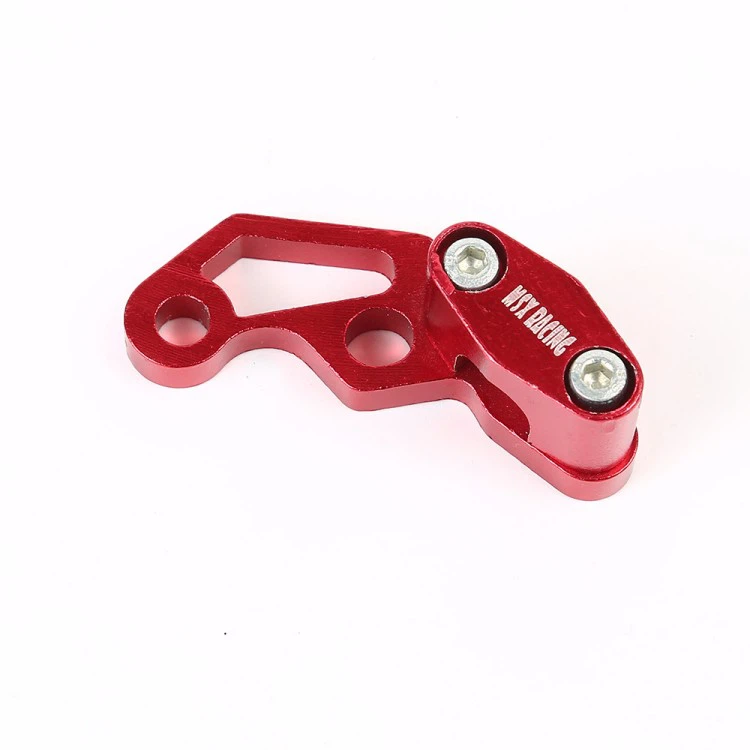

First off, let's talk about what a fixed support is. In simple terms, a fixed support is a device that's designed to hold something in place, preventing it from moving around. We see them in all sorts of applications, from industrial machinery to our everyday vehicles. Take motorcycles, for example. There are tons of fixed supports used in motorcycle modifications, like the Motorcycle Modified Cnc Parts Oil Pipe Clamp Honda General Aluminum Alloy Clamp For for Yamaha Xt660 Xt660r. This clamp is a type of fixed support that keeps the oil pipe in place, making sure it doesn't wiggle around and cause any issues.
So, how do these fixed supports actually resist movement? Well, it all comes down to a few key principles of physics. One of the main ways is through friction. Friction is the force that resists the relative motion between two surfaces in contact. When a fixed support is tightened onto an object, the surfaces in contact create friction. For instance, when you use a clamp like the one I just mentioned, the inner surface of the clamp presses against the oil pipe. The more you tighten the clamp, the greater the normal force between the two surfaces. And according to the laws of friction, the frictional force is proportional to the normal force. So, as you increase the normal force by tightening the clamp, the frictional force also goes up, effectively holding the oil pipe in place.
Another important factor is the design of the fixed support. A well - designed fixed support is engineered to distribute the forces evenly. Let's look at the Off - road Motorcycle Modification Accessories Titanium Ruler Balance Bar CNC Fixed Seat Bracket. This bracket is designed in such a way that it can handle the various forces acting on the seat during off - road riding. It has a specific shape and structure that allows it to transfer the forces from the seat to the frame of the motorcycle without causing any excessive stress on a single point. This even distribution of forces helps to prevent the seat from moving or getting damaged.
Material also plays a crucial role in how a fixed support resists movement. High - quality materials like aluminum alloy or titanium are often used in fixed supports. These materials are strong and durable, which means they can withstand the forces acting on them without deforming easily. For example, the CNC aluminum alloy adjustable motorcycle brake rocker arm Universal CNC five pointed star brake arm modification CNC adjustable brake lever Customizable color CNC motorcycle brake lever CNC rear brake rocker arm assembly is made of aluminum alloy. Aluminum alloy has a good strength - to - weight ratio, so it can provide the necessary support for the brake system while keeping the overall weight of the motorcycle down. The strength of the material ensures that the brake rocker arm can resist the forces generated when you apply the brakes, preventing any unwanted movement that could affect the braking performance.
In addition to these physical factors, the installation process is also vital. If a fixed support is not installed correctly, it may not be able to resist movement effectively. For example, if a clamp is not tightened properly, the frictional force will be insufficient, and the object it's supposed to hold may start to move. That's why we always provide detailed installation instructions with our products to make sure our customers can get the best performance out of our fixed supports.
Now, let's think about the different types of forces that fixed supports need to resist. There are static forces, which are forces that don't change over time. For example, the weight of an object resting on a fixed support creates a static force. The fixed support needs to be able to hold the object in place against this constant force. Then there are dynamic forces, which change over time. In the case of a motorcycle, when you're riding on bumpy roads, the forces acting on the fixed supports are constantly changing. The fixed supports need to be able to adapt to these dynamic forces and still keep the components in place.
When it comes to our products, we've put a lot of effort into research and development to make sure our fixed supports can handle all kinds of forces. We test our products under different conditions to ensure their reliability and performance. Whether it's a small oil pipe clamp or a large seat bracket, we want to make sure that our customers can trust our fixed supports to do their job.
If you're in the market for high - quality fixed supports for your motorcycle or other applications, we'd love to have a chat with you. We offer a wide range of fixed support products, each designed with the latest technology and high - quality materials. Our team of experts is always ready to help you find the right product for your needs. So, if you're interested in purchasing our fixed supports, don't hesitate to reach out and start a conversation about your requirements. We're confident that we can provide you with the best solutions for your fixed support needs.
References
- Halliday, D., Resnick, R., & Walker, J. (2013). Fundamentals of Physics. Wiley.
- Beer, F. P., Johnston, E. R., Mazurek, D. F., Cornwell, P. J., & Self, B. P. (2019). Vector Mechanics for Engineers: Statics and Dynamics. McGraw - Hill Education.


